
A child in 1950s Sweden insisted she was Anne Frank. Decades later, her story still challenges—and heals.

Legacy & Adaptation Note
This feature is adapted from Dr. Walter Semkiw’s original case write‑up on ReincarnationResearch.com, which he considered one of his most cherished and meaningful cases. We preserve Walter’s core documentation and extend it with a 2025 “where we are now” perspective, keeping his intention intact while adding clarity around methods and ethics.
The moment that changed everything.
In a modest Stockholm apartment in the early 1950s, a toddler told her startled mother: “I am not Barbro. My name is Anne Frank.” She recoiled from men in uniforms, panicked at showers, and later—at age ten—led her parents unerringly through Amsterdam to a house she had never visited, the Anne Frank House, asking why her posters were gone and why the rooms were empty.
That child was Barbro Karlén, who would grow up to be a bestselling Swedish poet and horse police officer—and, to many who met her, the living continuation of Anne Frank’s voice.
We revisit the case today with compassion, transparency, and method: what was reported, what held up, and what it might mean now.
What makes this case different
Unlike celebrity “match” stories that rely on intuitive readings, this is a children’s spontaneous‑memory case with multiple, independent lines of support:
- Early childhood memories (ages ~2–3): Barbro told her parents she was Anne Frank and that they were “not her real parents.”
- Trauma echoes (phobias & behaviors): fear of uniforms; aversion to showers; food quirks—each resonant with Holocaust context.
- Geographic memory (age 10): During a family trip, Barbro navigated to the Anne Frank House without directions and reacted to changes inside.
- Writing talent carried forward: Anne aspired to be an author; Barbro became one—publishing a hit poetry book at 12.
- Family recognition: Anne’s first cousin, actor Buddy Elias, met Barbro as an adult. Though initially skeptical, he described a powerful “soul connection” and regarded her as credible and trustworthy.
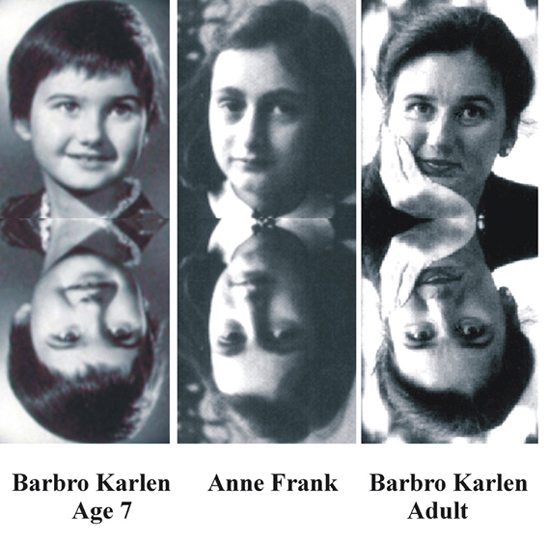
- Facial resemblance: Side‑by‑side comparisons of Anne and Barbro—at similar ages—show striking continuity in facial architecture.
(Source synthesis and case framing based on Walter’s published account and supporting materials.)
A careful look through Reignite’s 10‑Principle lens
To keep our evaluation consistent (and modest in tone), we map the core evidence to Walter’s widely used principles:
- Child memory statements: Clear, repeated identity statements from toddler age.
- Trauma carryovers: Phobias consistent with the prior life’s context (uniforms, showers).
- Geographic memory: Spontaneous orientation to the Anne Frank House (no prompting).
- Talent/mission continuity: Literary gifts realized early in the new life.
- Facial architecture: Noted resemblance (used cautiously as supportive, not conclusive).
- Relationship renewal (soul cohort): Emotional recognition with a past‑life relative (Buddy Elias).
- Change of religion/nationality: Jewish German teen → Christian Swedish child, underscoring identity fluidity.
8–10) Additional markers (birthmarks, xenoglossy, intermission): Not primary in this case; strength rests on memories, behaviors, recognition, and talents.
Bottom line: Multiple converging indicators—with an unusually strong geographic memory episode and a past‑life relative’s testimony—make this case exceptional among spontaneous child‑memory reports.
Where Walter left off—and why we’re continuing
Walter’s write‑up emphasized two things:
- The human encounter: Buddy Elias’s reaction after spending time with Barbro—his shift from skepticism to heartfelt recognition—mattered deeply to Walter.
- The social meaning: He highlighted how this case illustrates religion/nationality changes across lives, a perspective he believed could soften prejudice and sectarian division.
We carry his work forward by: (a) clarifying methods (children’s spontaneous memories vs. intuitive affirmations), (b) proposing gentle, modern validation tools (standardized face‑landmark overlays, timeline graphics), and (c) situating the story within a 2025 ethics framework (privacy, consent, no sensational claims).
The Amsterdam moment (age 10)
On a family visit, Barbro suddenly quickened her pace through unfamiliar streets and stopped before the building where Anne hid. Inside, she reportedly asked why the walls were bare and her posters missing—details a tourist wouldn’t intuit. For many readers of Walter’s account, this single episode—specific, public, unprompted—remains the most arresting.
A cousin’s testimony
When Barbro met Buddy Elias years later, they embraced and wept. Buddy would later say that Barbro was unlike others who had claimed to be Anne, describing a sincere person who left him with a “strange, positive sense of soul connection.” Walter cherished this piece of the story, not as “proof,” but as human corroboration from someone who loved Anne.
Skeptic’s corner (respectfully)
Reasonable questions deserve space:
- “Could she have learned it?” Barbro’s earliest statements occurred at ages when reading and historical study were implausible; the Amsterdam orientation was spontaneous.
- “Is resemblance enough?” No; we treat facial similarity as supportive context only.
- “Why no birthmarks?” Anne died of typhus; wound‑mark correspondences aren’t expected.
- “Memories faded in adolescence—isn’t that suspicious?” That fading is common in well‑documented child cases; it does not negate earlier, specific episodes.
Our editorial stance is curious, careful, and kind: this is a powerful spontaneous memory case, not a claim born of regression or a one‑off psychic reading. We present it as such and invite thoughtful engagement.
Why this case matters in 2025
For many, the case offers a bridge from horror to healing: a Jewish teenager’s life cut short in 1945, re‑emerging as a Swedish child who learns to live without fear, writes, serves, and forgives. If identity can cross religions, nations, and eras, then prejudice loses its footing. That was Walter’s hope—and ours.
In remembrance
Barbro Helen Margaretha Ask-Upmark (née Karlén) passed away on 12 October 2022. We hold her loved ones in our hearts. Barbro chose a quiet path outside the spotlight—writing, caring for horses, serving with mounted police, and, when invited, sharing parts of her childhood story to encourage compassion and understanding.
As we revisit her case in 2025, we do so with gratitude and respect: honoring her privacy and humanity, and acknowledging the comfort her memories have offered to families who’ve faced similar experiences.
If you’re new to children’s past‑life memories
- Memories often arise ages 2–5, fade by ~7–8, and may include vivid nightmares, matter‑of‑fact statements, and specific place knowledge.
- The most constructive parental responses are simple: listen, reassure safety, and record statements without leading questions.
- Comparison cases (e.g., same‑family returns, historically verifiable memories) provide patterns that help families feel less alone.
For a gentle primer and parent guidance, explore our forthcoming “Children’s Memories 101.”
In the meantime, you can visit and read about Childrens cases and discuss with our community questions of your own. Visit ReincarnationForum.com
Make a one-time donation
Make a monthly donation
Make a yearly donation
Choose an amount
Or enter a custom amount
Your contribution is appreciated.
Your contribution is appreciated.
Your contribution is appreciated.
DonateDonate monthlyDonate yearlyScan the QR Code Below to Share to Other Devices:



 REIGNITE
Leave a comment