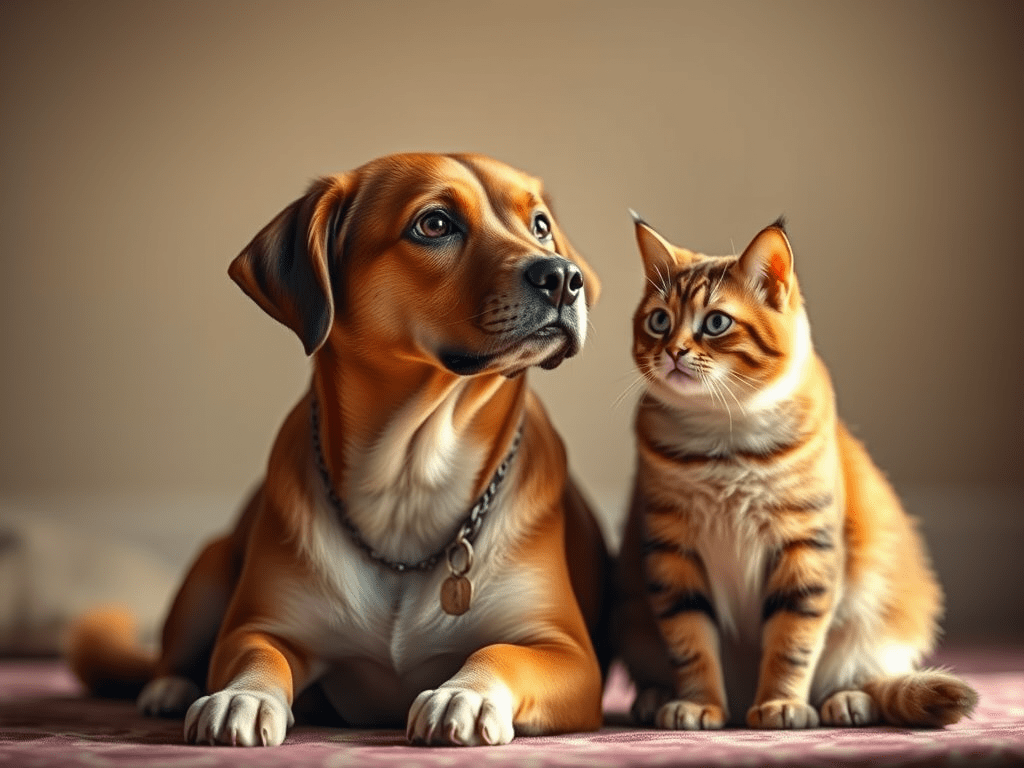
A deep-dive into doctrine, pet-owner stories, animal cognition science—and the rare cases that make the question harder to shrug off.

This article shares educational insights on reincarnation research methods and ideas. It does not give medical, psychological, or legal advice, nor does it claim any living individuals are reincarnations of specific people. Our tools and discussions help organize information based on published evidence, but they do not determine identity.
If you’ve lived with a dog or cat long enough, you’ve probably had at least one moment that felt… too human.
Maybe it was the way your dog sat beside you when you were falling apart, quietly “getting it” in a way that didn’t feel like training. Maybe your cat seemed to anticipate a conversation before you spoke. Maybe you’ve watched an animal learn your household’s unwritten rules faster than any creature “should,” and you caught yourself thinking: Who’s in there?
Here’s the question I want to explore with you today—open-mindedly, but with both feet on the ground:
What if some companion animals join human households as “intern souls”—incarnating in animal bodies on purpose to practice love, social belonging, and moral learning… on a reincarnational path that could eventually lead to a human birth?
That’s a big claim, and it deserves a careful approach. So in this long-form Reignite deep dive, we’ll look at four angles:
- What reincarnation traditions actually say about animal-to-human progression
- What pet owners around the world report—and why those interpretations cluster in certain cultures
- What cognitive ethology and neuroscience can (and can’t) explain about “human-like” animal behavior
- What counts as evidence in transpersonal research—and why a tiny number of cases deserve a second look
No gurus here. No certainty theater. Just a serious question and an honest attempt to map the territory.
Quick takeaways for TL;DR Readers
- Many reincarnation traditions affirm animal-to-human rebirth but disagree on its frequency and criteria for human incarnation.
- Pet owners often see empathic animals as “old souls,” particularly in cultures that believe in reincarnation.
- Modern science shows that some animals—especially dogs—are attuned to human social cues and bonding hormones, creating a “spiritual” feeling in daily life.
- Direct evidence for animal-to-human reincarnation is rare, but some documented anomalies exist as research targets.
- Even if you stay agnostic about reincarnation, studying “old soul” pets can teach us about animal minds and the stories humans build around love.
The “intern soul” hypothesis—stated clearly
Let’s define this idea in plain language.
The “intern soul” hypothesis says:
- Consciousness survives bodily death (a core claim of reincarnation)
- Consciousness can incarnate across species (animal ⇄ human, at least in one direction)
- Some animals—especially domestic companions—may choose (or be guided into) life with humans as a kind of apprenticeship
- The apprenticeship helps develop relational, cognitive, and karmic capacities associated with human life: empathy, cooperation, communication, self-control, and moral learning
- After death, that consciousness may be eligible for a human birth (or is at least “closer” to it)
This is not mainstream science. It’s a metaphysical hypothesis.
But it’s also not a random invention. Versions of it show up in multiple religious and esoteric systems, and it resonates with the lived experiences of many pet owners.
So the research question isn’t “Is this true?” in the simplistic sense. The smarter question is:
What would we expect to see—in doctrine, culture, behavior, biology, and case evidence—if something like this were happening?
What reincarnation traditions say about animal-to-human progression
If you ask five reincarnation traditions about animal-to-human rebirth, you don’t get one answer. You get a family of answers.
But there’s a surprisingly consistent theme across many systems:
Human incarnation is rare and valuable because it offers the widest range of choice, moral agency, and spiritual development.
From that perspective, an animal-to-human “upgrade” isn’t about being “better.” It’s about having access to a different kind of curriculum.
Hindu perspectives: the ladder and the lesson
In many Hindu frameworks, the soul’s journey through samsara involves movement through many forms. Some traditions describe a vast number of species or “life forms” a soul may experience before reaching a human birth.
The details differ by school, but the broad idea is familiar: the soul evolves through experience, karma, and the gradual awakening of discernment.
In this view, animal life can still generate karma and learning—especially around devotion, affection, loyalty, and service. But human life is where choice becomes sharp enough for liberation work.
So a household animal that lives in close relationship with humans could, in theory, gain exposure to a kind of moral-social environment that wild life rarely provides: routines, cooperation, mutual care, restraint, and “family.”
Buddhist perspectives: rebirth across realms, but human life is the sweet spot
Buddhism generally treats rebirth as possible across many realms. Animals, humans, hungry ghosts, and other forms are all part of a wheel of becoming.
Most Buddhist teachings emphasize that animal rebirth is difficult because it tends to involve fear, survival pressure, and limited reflective capacity. That said, Buddhism also emphasizes compassion precisely because every being is on the same wheel.
Buddhist stories and teachings often imply that a being can be reborn as human if karmic conditions align. The key is not species pride; it’s the opportunity of a human life to practice awareness and ethical discipline.
If you’ve ever looked at a dog who refuses to abandon you during your darkest weeks, you can see why people frame that as merit or spiritual development.
Jain perspectives: karma binds, liberation awaits every soul
Jainism is extremely strict about the moral reality of karma. Every soul is bound by karmic “matter” and must shed it through right conduct.
Jain ethics extend nonviolence to all beings because all beings are living souls—on different rungs of the karmic journey.
Jain cosmology allows movement between forms, including animal-to-human. But it insists that spiritual progress is tied to the reduction of violence, attachment, and ignorance—qualities any soul must confront, regardless of its form.
Theosophy: the “group soul” becomes an individual
Theosophical writers are unusually explicit about animals evolving toward humanity. In that model, many animals participate in “group souls,” but certain advanced animals—especially those closely bonded with humans—may individualize into separate reincarnating entities.
That language maps neatly onto what many pet owners already intuit:
“My dog isn’t just a dog. He’s someone.”
Whether you accept that metaphysics or not, it’s one of the cleanest doctrinal statements of the “intern soul” idea: pets, through love and mental stimulation, can accelerate toward human-level individuality.
Indigenous and folk traditions: kinship more than hierarchy
Many indigenous worldviews don’t frame animal-to-human movement as a linear ladder. They emphasize kinship, spirit relations, and reciprocal responsibility.
In some traditions, animals can be ancestors, guides, or fellow persons in different bodies. The boundary between human and animal is less absolute than in modern Western materialism.
Even without a “graduation” model, the underlying premise is similar: personhood is not limited to the human species.
So doctrinally, the intern-soul concept has roots. But doctrine alone doesn’t prove anything.
The next question is: why do modern people—especially pet owners—find this idea emotionally plausible?
Why so many pet owners say “this one is different”
Spend ten minutes in spiritual pet communities online and you’ll see a pattern:
Owners don’t just say their animals are smart. They say their animals are wise.
They talk about:
- A gaze that feels like recognition
- Emotional support that arrives before words
- Protection behaviors that look “chosen,” not trained
- An animal who seems to “teach” a human family patience, softness, or presence
- A sense that the relationship feels older than the current lifetime
From a research standpoint, there are at least three explanations that can coexist:
Human projection (anthropomorphism)
Humans are meaning-makers. When we love, we narrate. We pattern-match. We turn coincidence into story—especially when the story comforts us.
This is a real factor, and any serious project has to account for it.
Real animal cognition (no reincarnation required)
Animals—especially dogs—are far more socially intelligent than we once believed. Domestication selected for sensitivity to humans, and modern research continues to reveal surprising abilities.
A pet can truly be empathic, tuned-in, and socially responsive without any metaphysical explanation.
Cultural “permission structures”
People interpret experiences through the stories their culture already offers.
If reincarnation is a living belief in your family or religion, then a striking animal relationship may naturally be interpreted as a soul in development. If reincarnation is absent from your worldview, you may interpret the same behavior as “bonding,” “instinct,” or “training.”
That’s why ethnography matters. Not because believers are “wrong,” but because belief itself shapes how data is noticed, remembered, and shared.
Here is a simple “three-bucket” model for staying grounded
If you want a practical way to hold this topic without falling into either gullibility or dismissal, try this:
- Bucket 1: Known biology. Domestication, learning, temperament, reinforcement.
- Bucket 2: Human meaning-making. Projection, grief, narrative, selective memory.
- Bucket 3: The anomaly zone. Rare cases with unusual specificity, verification, or timing that don’t neatly fit buckets 1 or 2.
Most pet stories will live in buckets 1 and 2. That’s fine. It doesn’t make the love less real.
But bucket 3 is where research gets interesting—and where Reignite’s evidence-first curiosity belongs.
What science says: social cognition, bonding chemistry, and the “feels like a person” effect
Let’s get specific about what science can test.
The intern-soul hypothesis is metaphysical. Science can’t directly test “a soul’s intention.”
But science can test the behavioral and biological correlates that owners associate with “old soul” animals.
Here are three scientific domains that matter most.
Social learning and “human cue reading”
Dogs, in particular, are exceptional at reading human signals. They follow pointing gestures, respond to voice tone, and track our attention.
If you live with that every day, it can feel like mind-reading. But it may be the result of domestication + learning + individual temperament.
Still: individual differences matter. Some dogs are dramatically better than others at this. If owners are labeling the top percentile as “intern souls,” that’s testable.
A proposed study could run monthly social cognition tasks (object choice, gaze-following, imitation, cooperative problem solving) and see whether “old soul” dogs cluster at the high end.
Bonding hormones (oxytocin loops)
Research suggests that mutual gazing between dogs and owners can increase oxytocin in both—a biological bonding loop reminiscent of parent–infant attachment.
You don’t need reincarnation to explain that. But you can see why it feels spiritual.
If a subset of animals produces unusually strong bonding responses—faster oxytocin spikes, stronger stress buffering, deeper co-regulation—owners may perceive that as “this is not ordinary.”
Again: testable. Non-invasive saliva assays, heart-rate variability measures, and behavioral coding can quantify “the vibe.”
Self-representation and empathy-like behavior
Mirror self-recognition is one famous test, but it’s not the whole story. Dogs may not pass mirrors, but they show other signs of self-representation (like recognizing their own scent).
More importantly, animals show empathy-like responses: approaching distressed humans, matching emotional tone, and offering contact.
From a human perspective, empathy is one of the “most human” traits. So when we see it in an animal, the intern-soul hypothesis becomes emotionally compelling.
But we should keep open-minded skepticism: some behaviors may be learned responses to crying sounds, not compassionate intention.
So what would make the science interesting?
A pattern.
If “old soul” pets (as identified by owners) consistently show:
- Faster social learning curves
- Higher performance on communication tasks
- Stronger affiliative hormone responses with humans
- More consistent prosocial behaviors across contexts
…then something is going on—at least behaviorally. Whether that “something” is soul evolution or a combination of genetics + environment remains the philosophical question.
Either way, the findings would matter.
The anomalies: do we have any evidence of animal-to-human reincarnation?
This is where the conversation usually splits:
- Some people say: “There’s tons of evidence. Just listen to what mediums say.”
- Others say: “There’s no evidence. It’s impossible.”
- A third group says: “Most evidence is weak, but a few cases are strong enough to take seriously.”
As an author researching the topic, I tend to live in that third group.
In the broader reincarnation literature, the strongest cases tend to involve young children who report spontaneous memories of a previous life, sometimes with verifiable details.
Animal-to-human cases are rarer—but they’re not nonexistent.
When you do find a report where a child claims a previous animal life and includes verifiable details, it’s worth a closer look—not because it proves the theory, but because it gives you a research target:
- What kinds of claims are made?
- What can be checked?
- What alternative explanations exist?
- How does the story evolve over time?
And just as important: what would a rigorous evidence rubric even look like?
If we were auditing cases for research, we’d want to surely rate:
- Specificity of the claim (names, places, events, physical marks)
- Verification (independent corroboration, documents, witnesses)
- Opportunity for normal information transfer (did the child have access?)
- Consistency over time (does the narrative shift dramatically?)
- Psychological factors (suggestibility, coaching, family beliefs)
This is the difference between curiosity and credulity.
A research program we could actually run…if we wanted to test this concept.
If we took the intern-soul hypothesis seriously as a research question, I’d propose a four-phase approach that mirrors the broader Reignite method: doctrine + culture + behavior + evidence audit.
Phase 1: Doctrinal map (i.e. text and tradition)
Goal: Map what reincarnation-affirming systems claim about animal-to-human progression.
Deliverable ideas:
- A comparative table: “What qualifies an animal soul for human rebirth?” (karma, devotion, moral learning, volition, grace)
- A glossary of key terms (samsara, karma, jiva, group soul, realms)
- A “where traditions agree / disagree” synthesis
Phase 2: Global ethnography (i.e. what people experience and how they interpret it)
Goal: Interview pet owners across multiple cultures and belief systems.
Key question: Are “intern soul” narratives culturally clustered—or do they appear cross-culturally with similar motifs?
Data sources:
- Semi-structured interviews
- Digital ethnography (forums, spiritual pet communities)
- Narrative coding (recurring themes, moral framing, relationship language)
Phase 3: Behavioral + neuroendocrine study (i.e. the measurable signature question)
Goal: Test whether pets labeled as “old souls” show measurable differences.
Theoretical Process: (I thought this out quickly)
- Cohort: 60 companion animals (dogs and cats), matched by breed/age/household factors
- Measures: monthly cognition tasks + non-invasive hormonal sampling (where ethical)
- Variables: owner belief measures (reincarnation belief scale, attachment measures), animal temperament, training history
- Analysis: multilevel models, controlling for confounds (training time, breed traits)
Phase 4: Transpersonal case audit (i.e. evidence quality, not sensationalism)
Goal: Evaluate reported animal-to-human cases using a transparent rubric.
Output:
- A ranked list of cases with “why this ranks high/low”
- A public-facing explanation of what counts as strong evidence
- A set of research questions generated by the highest-quality anomalies
This approach doesn’t assume the conclusion. It lets the data and traditions speak.
Ethical ground rules
Any reincarnation research discussion that touches animals and reincarnation needs clear ethics.
Here are the guardrails I’d put in place if this were tested:
- Animal welfare first: Duh. Meaning…no invasive procedures just to chase a metaphysical question.
- No identity adjudication: we don’t declare that a living person is the reincarnation of a specific past individual.
- No pressure narratives: no one should feel obligated to treat a pet as a “future human” or view animal life as merely a stepping stone.
- Privacy: protect the identities of families, minors, and anyone sharing sensitive experiences.
- Psychological caution: if a reader is grieving a pet and latching onto reincarnation as a guarantee of reunion, we should be compassionate and avoid certainty claims.
In short: curiosity with care.
The bigger question beneath the big question
You might notice something: even if the intern-soul idea turns out to be wrong, this conversation still matters.
Why?
Because it forces us to ask what we mean by:
- consciousness
- personhood
- moral learning
- love across species
- the reality (or illusion) of boundaries between “human” and “animal”
If animal reincarnation is real, then compassion becomes practical, not sentimental. You aren’t just being nice to “a lesser creature.” You’re interacting with a being on a journey.
If you are a skeptic at heart, the question still invites humility: animals may be far richer internally than our old stories allowed.
Either way, the result points in the same direction: deeper respect.
Your turn – tell us what you think!
If you’ve had an animal companion that felt like an “old soul,” tell us:
- What exactly happened that made you think, “This is different”?
- Which behaviors stood out most: empathy, problem-solving, communication, protection, “recognition”?
- What is your cultural/religious background (if you’re comfortable sharing)? Did it influence how you interpreted the experience?
- Do you see the intern-soul idea as literal (a real reincarnational path) or symbolic (a way of describing a bond)?
- If we built a research project around this, what would you want measured?
And for the skeptics (who are always welcome here, too):
- What kind of evidence would shift your probability even slightly?
- What would count as a fair test?
In the end, I think that we are all here to learn—together.
Further reading:
- University of Virginia Division of Perceptual Studies (reincarnation case research)
- Duke Canine Cognition Center (animal cognition research)
- Ian Stevenson and Jim Tucker’s published case investigations
- Comparative religion texts on samsara and karma (Hindu, Buddhist, Jain sources)
- Theosophical writings on animal “group souls” and individualization (as a doctrinal lens)
Scan below to share across devices:

Help Us Keep This Work Grounded and Accessible
Reignite exists to explore questions like this carefully—without sensationalism, without dogma, and without dismissing lived experience. Researching reincarnation responsibly takes time, archival access, technical tools, and the ability to bring together scholars, experiencers, and families in a respectful way.
If this article helped you think differently, feel less alone in your questions, or gave language to something you’ve experienced but never quite named, please consider supporting our work. Donations help us preserve research archives, build better tools for experiencers, and continue publishing thoughtful, evidence-aware content for the public.
Every contribution—large or small—helps keep this conversation open, ethical, and available to anyone seeking understanding.
Make a one-time donation
Make a monthly donation
Make a yearly donation
Choose an amount
Or enter a custom amount
Your contribution is appreciated.
Your contribution is appreciated.
Your contribution is appreciated.
DonateDonate monthlyDonate yearly

 REIGNITE
Leave a comment