


How to Read This Case
This is not a claim of proof, nor an invitation to belief. It is a documented research narrative that moves step-by-step from subjective experience to independently verifiable data. The original 2019 published case can be found here, written by Walter Semkiw)
You can listen ALSO to this October 2025 case interview on ReincarnationPLR.com where Marilyn Elliot and Chuck McMurray discuss the experience and references to the case.
Introduction: The Engineer Meets the Mystic
As a Chicago Southside native raised Irish Catholic, my journey into reincarnation research didn’t begin in a temple or a séance circle—it began in data. For more than twenty-five years I’ve worked in software, geospatial analytics, and artificial intelligence, helping large organizations make sense of complex systems. Somewhere along the way, those same instincts for pattern recognition and validation bled into a far more personal experiment: Could the same analytic methods used in AI help trace a human soul across centuries?
What started as curiosity became a longitudinal study—one that led me to identify a past life as John Harrison (1693-1776), the self-taught English clockmaker who solved the problem of measuring longitude at sea.
The following case outlines the exact process I used—from Past Life Regression (PLR) to independent validation through Ahtun Re via Kevin Ryerson—so that others can replicate the path using evidence-based spirituality and disciplined research.
This case is not an assertion of spiritual authority, a claim of personal significance, or an attempt to prove reincarnation as fact. It is an experiment in method: whether subjective past-life recall can be documented, constrained, and tested against external data without prior contamination.
Stage 1: Establishing Intention and Method
In 2015 I booked a session with Susan Wisehart, a licensed therapist known for her work in Soul Visioning and Past Life Regression. My objective wasn’t to find anyone famous. It was to gather verifiable data—a coherent life narrative that could be cross-checked historically. Susan’s advice was simple: “Treat this as an adventure. Record everything. Expect nothing.”
That mindset—record before interpretation—became foundational. Like a field scientist, I documented every sensory detail, emotion, and object described during the regression.
Only later would those fragments be tested against external data.
Stage 2: The Regression Itself
Scene 1 – The Bridge
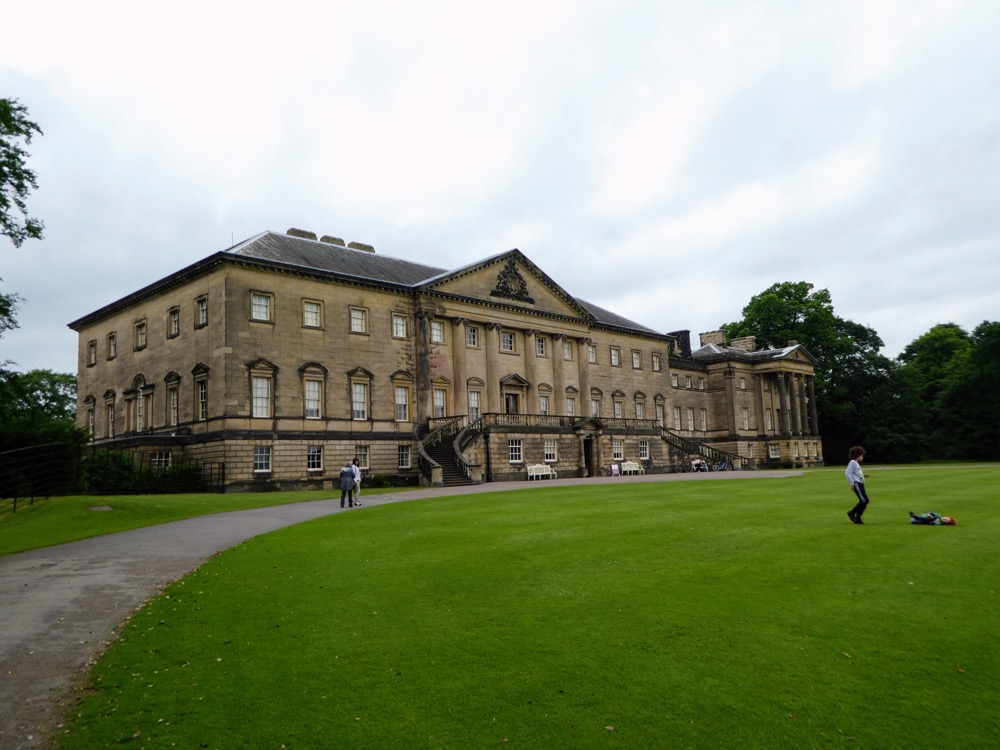
Under light hypnosis I found myself walking across a fog-shrouded bridge. The air was damp and cold. I looked down: leather boots, a long coat, and a faint red trim on the garment. Ahead stood an immense castle-like estate surrounded by manicured grounds. When prompted for location, the word “Yorkshire” came to mind—though as a lifelong Chicagoan I couldn’t have placed Yorkshire on a map.
Scene 2 – The Soldiers by the River
I saw myself and a friend by a river, dressed as young soldiers—“playing at soldiering,” I told Susan. We laughed at carriages passing on a gravel road, at the extravagance of wigs and gowns. It felt like England in the 1700s, though I had no prior interest in that era.
Scene 3 – The Convalescent Hall
The imagery shifted to a modest hospital or convalescent hall. Children and young men in loose cotton clothing lay in cots. I was ill, weak, but being cared for. Later research revealed that John Harrison contracted smallpox as a child, an illness that confined him indoors—where he was given a watch to occupy his time, the moment that sparked his obsession with timekeeping.
Scene 4 – The Clock Shop
Next I appeared as a middle-aged man in a narrow clock shop. Every wall ticked with mechanisms—dozens of pendulums, brass gears, and candlelight glinting off glass faces. I lived above the shop, climbing steep stairs to a cramped apartment. Customers visited to “set their watches by me,” a phrase I repeated several times during the recording.
At the workbench were drawings and inventions, one bound in a leather-spotted book, perhaps cow-hide. I felt deep pride but also a hollow anxiety about letters from a son named William. I frequently visited a local post office, waiting for word of his return.
Scene 5 – The Final Hours
In the closing scene I was older, exhausted, clutching my chest as the clocks around me ticked in unison. My final thoughts centered not on wealth or recognition but whether my son had written back. Then, silence.
The entire session lasted ninety minutes. The precision of the details—the bridge, the Yorkshire setting, the name William, the clock shop above the stairs—haunted me.
They felt like memories, not imagination.
I couldn’t explain it. I still can’t. But it changed me, forever.
Stage 3: From Experience to Evidence
Following regression protocol, I created a Claims Ledger—a spreadsheet with four columns:
| Claim | Source | Status | Notes |
|---|---|---|---|
| English countryside, “Yorkshire,” bridge, castle-like estate | PLR | Testable | Later matched Nostell Priory grounds |
| Clock shop with steep stairs, many clocks, book of inventions | PLR | Partially corroborated | Harrison’s workshop in Barrow upon Humber fit description |
| Collaborator: metallurgist / blacksmith nearby | PLR | Corroborated | Matched George Graham, instrument-maker ally |
| Letters from son William | PLR | Probable | William Harrison managed sea trials; correspondence plausible |
| Heart pains at death | PLR | Unverified | No historical medical record |
Only after this documentation did I begin historical research.
Searching for “clockmaker, England, 1700s, father and son” yielded endless results, but none aligned—until one morning in April 2018 something extraordinary occurred.
Stage 4: The Discovery Moment
It was my second day at a new analytics job—April 3rd, 2018—when I opened Google to see that day’s “Doodle.” It depicted a man in a powdered wig repairing clocks behind a counter. The caption read: (you can click the google listing here: “Celebrating John Harrison’s 325th Birthday.”
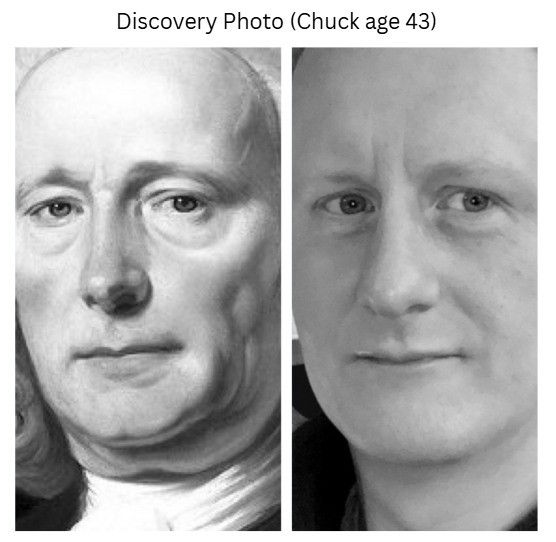
I froze. The date—4/3/18—was also the year I turned 43. The coincidence was mathematical poetry: 4-3-18 ↔ 43 years old ↔ Harrison’s birthday.
The man in the image looked unnervingly familiar.
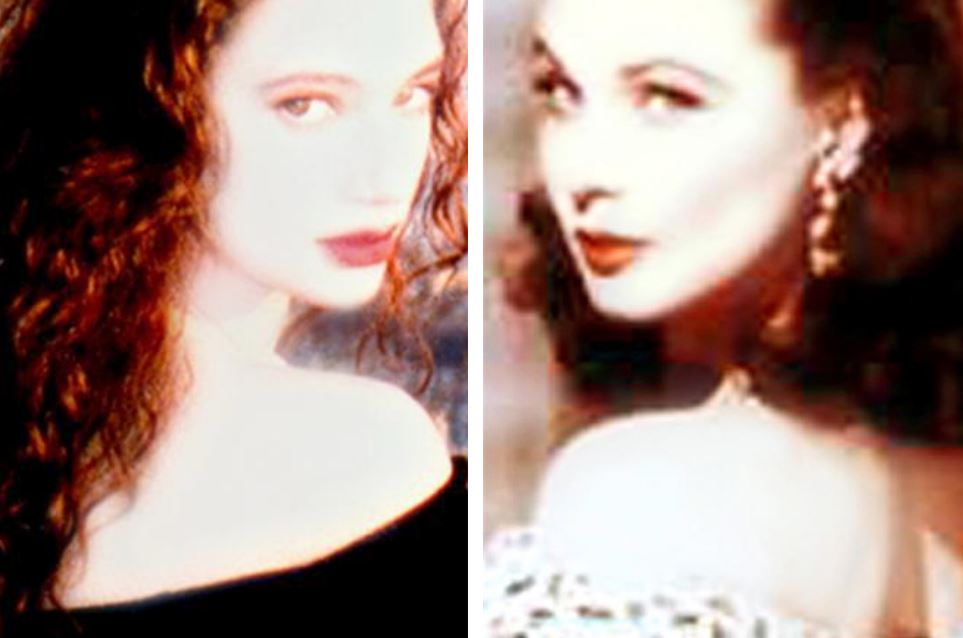
Later, I ran a facial-recognition comparison using an algorithm I’d developed for AI in that same year. The ArcFace cosine similarity returned 0.87 (on a 0-1 scale, 1 being the exact same face)—statistically high for two different portraits. That was the moment the my hypothesis became a lead.
Stage 5: Historical Correlation
Digging deeper, I learned:
- John Harrison, born in West Riding of Yorkshire, was indeed the son of a carpenter named Henry, who worked at Nostell Priory—the exact same castle-like estate seen in my PLR.
- He contracted smallpox as a boy and was gifted a watch, sparking his lifelong pursuit of accurate timekeeping.
- He operated clock shops throughout his life, working obsessively to refine the marine chronometer.
- His son William Harrison oversaw sea trials, including a six-month stranding in Jamaica—a fact explaining the anxiety and repeated post-office scenes in my regression.
Each discovery mirrored an image or emotion from the PLR, forming a coherent data cluster: bridges → Yorkshire → clock shop → letters from William → died old age. These weren’t random correspondences; they were correlated anchors.
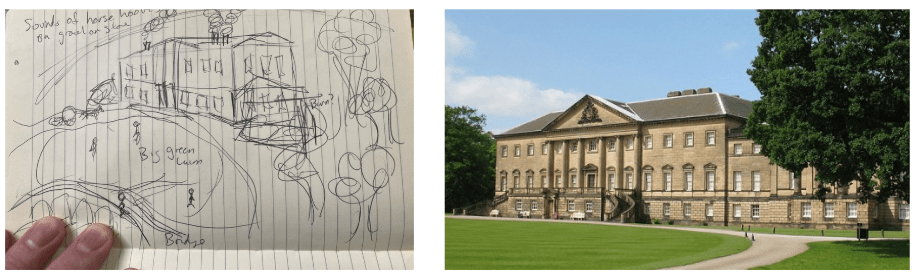
(Photo Courtesy of TheLoveTravellingBlog.com)
Stage 6: Independent Verification via Ahtun Re
After establishing a self-contained case file, I approached Kevin Ryerson, the trance medium who channels Ahtun Re, a spirit entity known for precise historical readings. This was in October 2019, months after my PLR data and historical matches had been logged.
In session, Ahtun Re independently affirmed that I had been John Harrison, and that my present-day family paralleled that life:
- My son Matthew McMurray corresponds to William Harrison, sharing both resemblance and collaborative dynamics.
- My wife Kimberly corresponds to Elizabeth Harrison; Elizabeth died in 1777 at 72, while Kimberly was born July 2, 1977—another eerie echo.
- Ahtun Re further noted continuity through five lifetimes devoted to measuring time and place—including roles in ancient Egypt (crop-calendar engineering) and Greece (the Antikythera Mechanism), leading to my current life in AI and geospatial analytics.
This was not blind validation; it was triangulation—an independent channel confirming patterns already evidenced.
Stage 7: The Synchronistic Chain
1. The Grasshopper Mechanism
John Harrison’s first major innovation was the Grasshopper Escapement, a friction-free clock mechanism. At age 10 I fixated on building a remote-control car called the Grasshopper —assembling it from scratch without instructions. That design, powered by gears and balance, unknowingly reenacted the same mechanical logic Harrison pioneered.
2. The Drone Blueprint
In 2020, while sketching drone-mapping concepts with my son Matthew, I drew a rotational geometry to optimize aerial grid coverage.
When placed beside Harrison’s H1 chronometer, the resemblance of structure was astonishing: concentric gearing, suspension points, and stabilizing frames identical in layout.
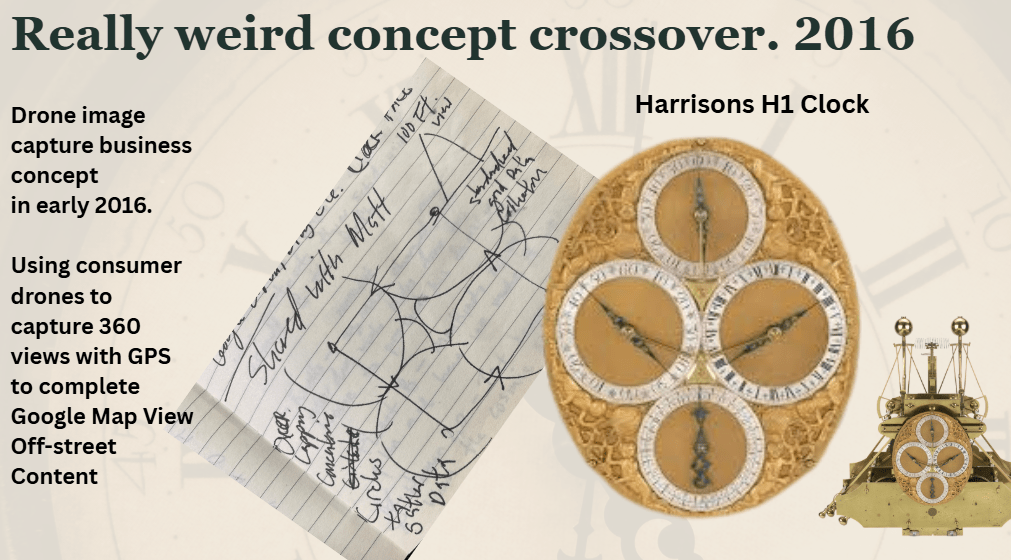
Different century, same geometry of thought.
3. Familial Resonance
Matthew later underwent his own regression. He described being “lost on an island after a sea voyage”—mirroring William Harrison’s stranding in Jamaica. These familial overlaps suggest group reincarnation, a pattern documented in numerous Stevenson-Semkiw cases.
4. Documentary Evidence in Australia
In 2025, while mining archival data for a presentation to the Cayce ARE, I located a 208-page manuscript donated to the State Library of Victoria in 1947 by a descendant R.A. Harrison. The binding cover matched my PLR description—“spotted cowhide.” This discovery also reopened the possibility of genetic confirmation via living descendants in Australia—a potential future phase of validation.
Stage 8: Analytical Reflection
From an AI standpoint, this case exemplifies a multi-modal inference model:
| Modality | Input | Output | Confidence |
|---|---|---|---|
| PLR (Session) | Sensory, emotional, linguistic data | Candidate identity pattern | Medium |
| Historical Record | Biographical, geographical data | Match metrics | High |
| Ahtun Re Reading | Independent symbolic data | Cross-validation | High |
| Synchronistic Events | Statistical anomalies | Pattern reinforcement | Variable |
The strength lies not in any single line of evidence but in the convergence across independent modalities. As in machine learning, signal consistency across diverse datasets raises confidence far more than volume alone.
Note: Not all evidence presented here carries equal weight. Historical records and pre-discovery PLR claims form the primary evidentiary core. Facial resemblance, synchronicity, and intuitive affirmation are treated as secondary corroborative signals, not standalone proof. This weighting is intentional and consistent with conservative research standards.
Stage 9: Lessons and Protocol
For researchers wishing to replicate this method, here is the distilled framework used by Chuck McMurray in research of the case:
- Set Intention & Hypothesis.
Define your purpose (healing, curiosity, research). Avoid “fame hunting.” - Conduct a Professional PLR (with a qualified, published regressionist!)
Record video/audio. Immediately transcribe. Tag every noun, place, person, and artifact. The regressionist for this case was Susan Wisehart. - Extract Testable Claims.
Focus on specifics: geography, profession, relationships, technology, emotional tone. - Delay Historical Lookup.
Do not research before the regression. Avoid front-loading bias. - Create a Claims Ledger.
Track each element across sources with corroborated / unknown / contradicted status. - Cross-Reference Public Records.
Verify only after transcription. Use genealogy databases, maps, archives, and visual imagery tools. - Seek Independent Validation.
Schedule an Ahtun Re session, considered by many to be the most accurate source for spiritual seeking and lifetime matching. Sessions may take place before or after formal evidence gathering. - Document Synchronistic Events.
Record date, context, and statistical rarity. Treat them as supplementary, not primary, data. - Integrate Findings into Present Life.
Identify transferable talents or emotional themes. The goal is growth, not nostalgia. - Publish Transparently.
Share data, transcripts, and uncertainties. Credibility grows through openness.
This loop—PLR → Research → *Ahtun Re → Synthesis—is replicable, scalable, and suitable for database-driven reincarnation studies.
*In my own Harrison case, I turned to Ahtun Re for confirmation after my initial research—and the result went far beyond validation, uncovering additional traceable lifetimes that have since been corroborated through research and will be shared in a forthcoming text.
Stage 10: Meta-Level Meaning
Beyond the factual alignment, the psychological integration has been profound. Understanding Harrison’s perseverance reframed my own life patterns: long engineering sprints, intolerance for imprecision, and the drive to “solve time” through data systems.
Harrison’s lifelong mission—to measure longitude and give navigators certainty—mirrors my current mission: to build AI tools that help souls navigate self-knowledge.
My recent project, the AI-Assisted Digital Soul Dossier, applies algorithmic matching to reincarnation data, enabling others to search lifetimes with the same rigor that I applied to mine.
“In that sense, the circle closes. Harrison built a clock to help humanity find its place on the oceans; I am building an AI to help humanity find its place within consciousness. Both are instruments of orientation—designed to help souls locate themselves across space, time, and many lifetimes.”
Conclusion: The True Longitude Prize
If this identification is accurate—and the convergence of evidence suggests it is—then perhaps the true Longitude Prize isn’t the marine chronometer at all. It’s the human capacity to track continuity of purpose across centuries: craftsmanship, curiosity, and devotion carried forward life after life.
Through disciplined PLR, critical comparison, and independent validation, we can approach reincarnation not as faith but as researchable continuity.
What once seemed mystical now feels measurable—a data-driven spirituality that honors both the scientist and the soul.
As Harrison once gave the world a way to keep time at sea, may this method help others keep time with their own spiritual evolution.
If You’re Reading This As…
• A skeptic: Review the Claims Ledger and verify dates independently.
• A researcher: Examine the regression transcript and pre-discovery timestamps.
• An experiencer: Focus on the protocol, not the identity.
• A historian: Evaluate the specificity of Yorkshire-era correspondences.
_______________________________________________________________________________
If this work resonates with you, consider supporting it.
Your donation helps continue the exploration of reincarnation, memory, and the long arc of the soul’s journey.
Make a one-time donation
Make a monthly donation
Make a yearly donation
Choose an amount
Or enter a custom amount
Your contribution is appreciated.
Your contribution is appreciated.
Your contribution is appreciated.
DonateDonate monthlyDonate yearly

 REIGNITE
Leave a comment