
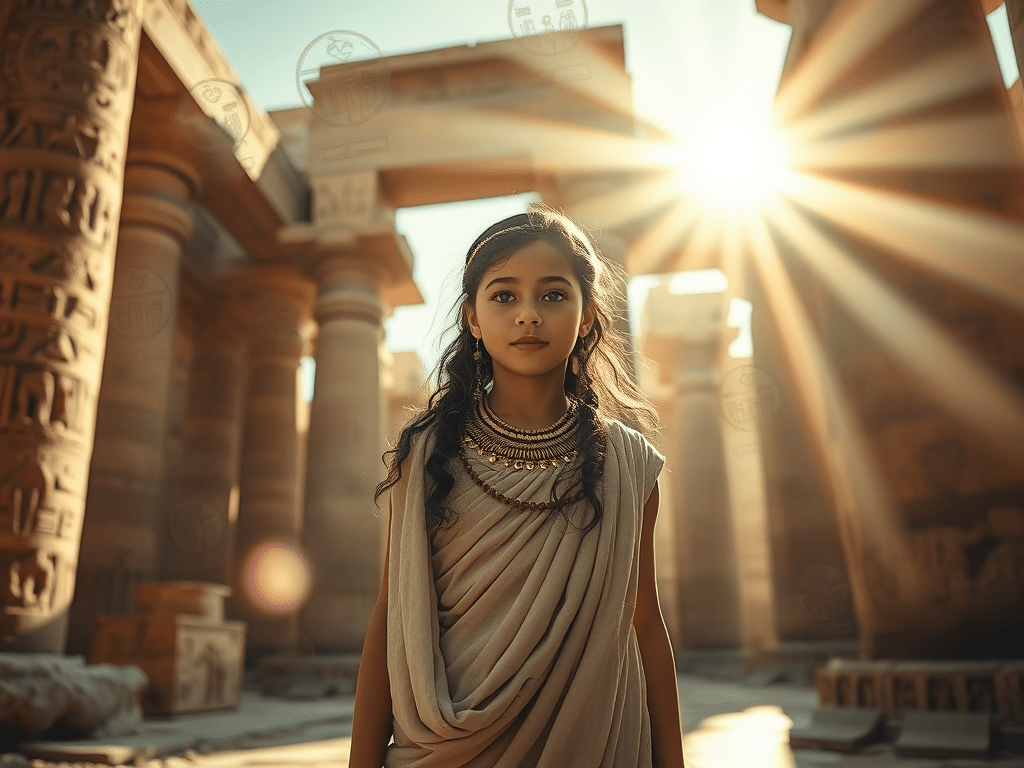
How a British girl’s fall down the stairs became one of the 20th century’s strangest Egyptology stories—and what survives of it under the archaeologist’s lens.

Why Omm Sety Still Haunts Us
Every few years the story of Dorothy Eady—better known by her Egyptian name, Omm Sety—returns to public view. The latest revival came through The Why Files video “Proof of Reincarnation | Dorothy Eady: Ancient Egyptian Priestess Reborn.” The program retells a tale that has captivated journalists and mystics for nearly a century: a London child presumed dead after a fall in 1907 who awoke speaking with a foreign accent, yearning for a land she had never seen, and who later proved to know Egypt’s ancient temples as if she had built them herself.
But between miracle and myth lies a real woman—a working Egyptologist, meticulous draughtswoman, and translator whose career helped document the Temple of Seti I at Abydos. She earned the respect of scholars even as she claimed memories of a priestess named Bentreshyt, lover of Pharaoh Seti I.

This review examines the factual core of that legend. Using verified records and the archival analysis compiled in Dorothy Eady (“Omm Sety”) – Fact-Checking a Reincarnation Legend, we’ll separate what archaeology confirms from what later storytellers—and perhaps Dorothy herself—embellished.¹
1 · A Life Between Two Worlds
Childhood and Awakening (1904 – 1914). Born January 16 1904 in Blackheath, London, Dorothy Louise Eady was the only child of Reuben Ernald Eady and Caroline Mary Eady. At age three she fell down a flight of stairs, was declared dead, then revived an hour later. There is no surviving medical record of cardiac arrest, but family testimony agrees she was unconscious long enough for the doctor to issue a death certificate.² Soon after, she began insisting she wanted to “go home”—meaning not London but a sun-lit place of columns and gardens.³
A 1908 visit to the British Museum’s Egyptian Hall triggered the defining moment: she kissed the feet of statues, crying, “These are my people!”
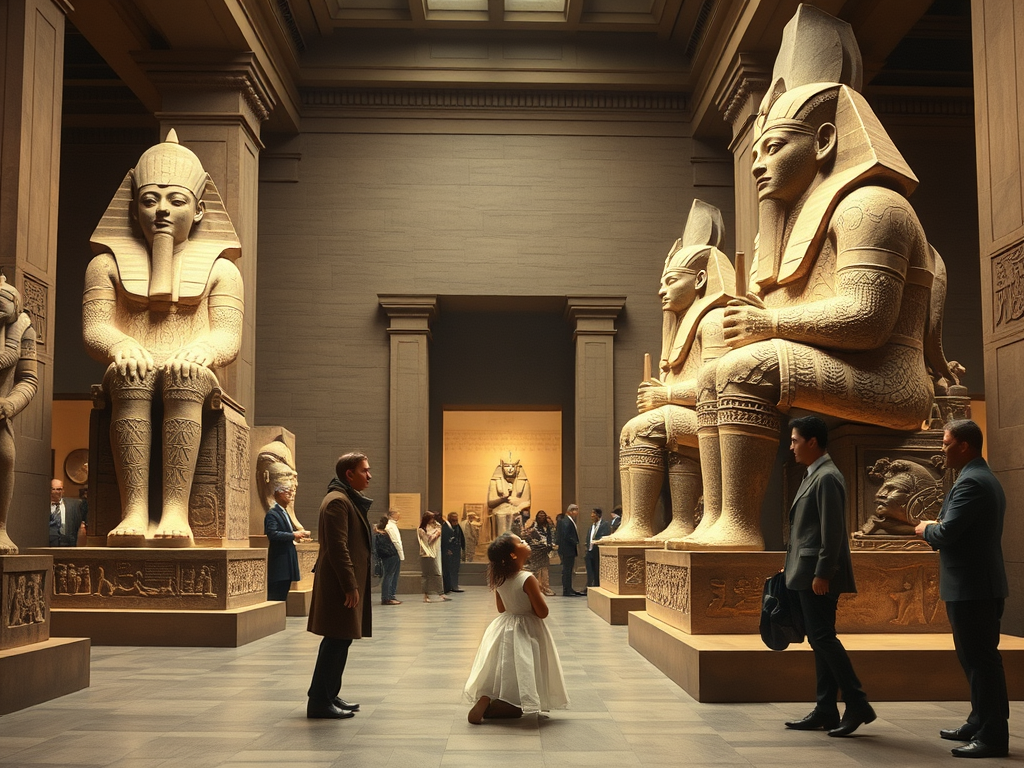
Curator E. A. Wallis Budge befriended the precocious girl and encouraged her study of hieroglyphs.⁴ By adolescence she claimed dreams of a temple filled with papyrus pools and the voice of a man called Hor-Ra dictating pages of hieroglyphs she could not later translate.⁵
From London to Cairo (1931 – 1935). After brief work in theater and a nationalist magazine, she married Egyptian student Imam Abdel Meguid in 1931 and sailed to Cairo—“home at last,” she said, kneeling to kiss the ground.⁶ The marriage soon collapsed, but motherhood rooted her in Egypt. Her son Sety, born 1933, gave her the Arabic title Omm Sety—Mother of Sety.
An Unorthodox Egyptologist. From 1935 through the 1950s she worked under archaeologists Selim Hassan, Ahmed Fakhry, and Labib Habachi, drafting site plans and translating hieroglyphic inscriptions. She was the first woman officially employed by the Department of Antiquities.⁷ Colleagues tolerated her barefoot temple prayers because her copywork was precise and her linguistic memory extraordinary.
2 · Testing the Myth
The historical record allows five principal “miracle” claims. Each can be measured against contemporary testimony.
| Claim | Year | Evidence | Outcome |
|---|---|---|---|
| Identified unseen wall scenes in darkness | c. 1952 | Inspector’s diary, later corroboration by colleagues | *Anecdotally verified.*⁸ |
| Described location of temple garden | 1950s | Excavation revealed tree-root pits | *Confirmed.*⁹ |
| Indicated hidden tunnel under temple | 1950s | Subterranean passage discovered | *Confirmed (probable water conduit).*¹⁰ |
| Predicted site of Nefertiti’s tomb | 1973 | 2015 radar anomalies inconclusive | *Unproven.*¹¹ |
| Claimed “Hall of Records” beneath Sphinx | 1950s | GPR shows only natural cavities | *Discredited.*¹² |
Each “hit” involved topographical memory, not psychic revelation. The garden and tunnel discoveries were witnessed by inspectors; no documents show trickery or prior access. The failures—the Sphinx and Nefertiti claims—reflect how folklore accreted around her name long after her death.
3 · Omm Sety Among the Scholars
Between 1956 and 1969 she lived beside the Temple of Seti I in the village of Arabet Abydos, often sleeping inside the ruins. She catalogued reliefs, drafted plans later published by Edouard Ghazouli, and served visiting Egyptologists as local guide and translator.¹³ Villagers nicknamed her el-Seto ova, “the wise lady of Seti.”
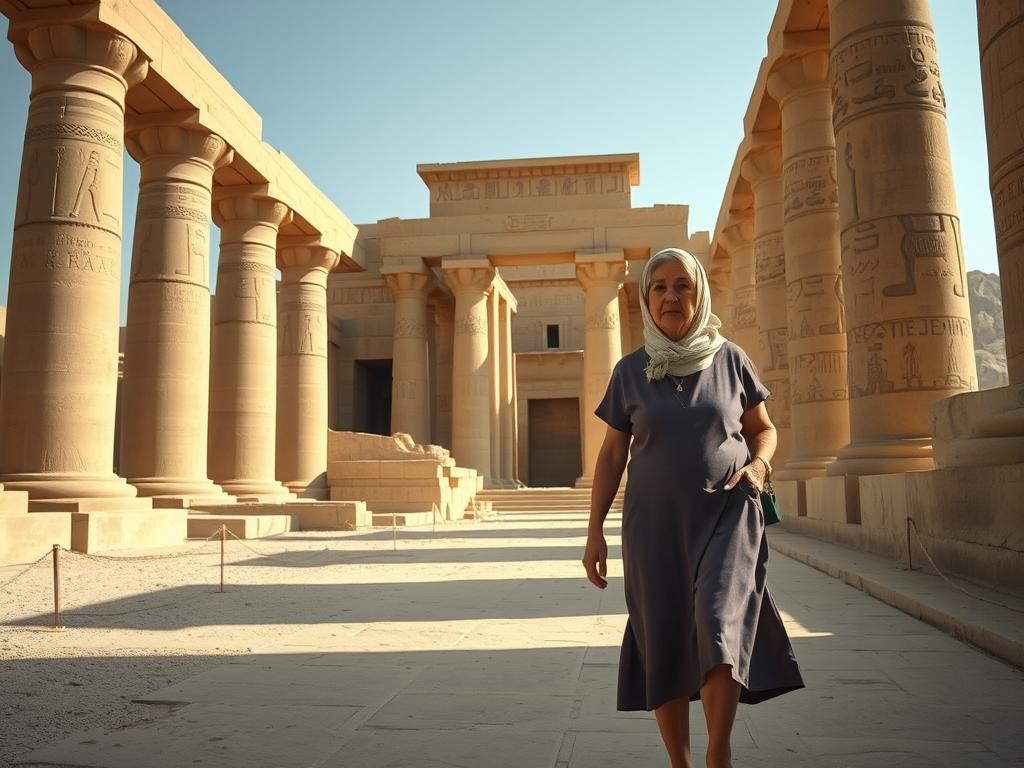
When the BBC filmed Omm Sety and Her Egypt (1980), she was seventy-six, walking with canes but still climbing the temple’s sandstone stairs. The broadcast mixed skepticism with awe. The Times reviewer wrote: “Could it be eyewash? Of course it could. Yet in any case it makes marvellous television.”¹⁴
Her colleagues judged her sanity by results: excellent drawings, accurate translations, no delusion in daily work. Egypt’s Antiquities Service extended her employment past retirement because, as one director wrote, “Her knowledge of Abydos cannot be replaced.”¹⁵
4 · Comparative Evidence – Children Who Remembered Before
Reincarnation research recognizes four landmark cases for comparison:
- The Pollock Twins (England, 1958) — identical twins born after sisters’ deaths, displaying matching birthmarks and memories; investigated by Ian Stevenson. Verdict: partially verified.¹⁶
- James Leininger (U.S., 2000s) — two-year-old recalling WWII pilot James Huston Jr.; records confirmed names, ship, and crash details. Verdict: strongly verified.¹⁷
- Ryan Hammons (U.S., 2010s) — four-year-old recalling Hollywood agent Marty Martyn; 55 facts verified, including birth certificate correction. Verdict: strongly verified.¹⁸
- Dorothy Eady/Omm Sety (England–Egypt, 1904–1981) — adult case, self-reported memories emerging after trauma; supported by archeological accuracy but no controlled testing. Verdict: partially verified (anecdotal).¹⁹
Unlike the children, Eady’s memories could not be independently recorded before interpretation. Yet her objective contributions—the garden, tunnel, and temple plans—represent tangible knowledge that begs explanation. Whether those came from intuitive recall, obsessive study, or extraordinary perception, they remain part of Egyptology’s usable data.
5 · Belief, Culture, and Gender
Ancient Egyptian religion prized resurrection, not reincarnation. The soul’s goal was eternal life in the Field of Reeds, not rebirth in a new body.²⁰ Dorothy’s conviction that she had been a priestess was therefore a modern synthesis, blending Theosophy, Buddhism, and Western spiritualism.
Victorian Britain viewed past-life belief as exotic; post-colonial Egypt saw her devotion as charming if eccentric. Her barefoot prayers offended neither Muslims nor Christians in Abydos because she showed equal reverence for Ramadan and Coptic Christmas.²¹
Gender mattered. A male academic claiming to be Seti I reborn might have been dismissed; a woman invoking love and memory fit romantic tropes stretching from Aida to The Mummy. Journalist Jonathan Cott titled his biography A Story of Eternal Love to frame her as mystic heroine.²²
Modern feminist scholars like Barbara Lesko later reframed her legacy: “She developed into a first-rate draughtswoman and prolific writer—an Egyptologist who happened to believe she had lived before.”²³ The reframing reclaims her from the margins of “eccentric mystic” to “self-taught professional.”
6 · Science, Skepticism, and the Mind
Skeptics note that a head injury at age three could have caused foreign accent syndrome and temporal-lobe changes associated with hyper-religiosity or vivid visions.²⁴ Some psychiatrists classify her experiences as a creative integration of trauma—a child’s brush with death translating into lifelong symbolic narrative.
Carl Sagan cited Omm Sety as a cautionary example in The Demon-Haunted World: “The facts are impressive; the conclusions extravagant. Extraordinary claims require extraordinary evidence.”²⁵
Parapsychologists offer alternative explanations: ESP or access to a collective memory field. Remote-viewing researcher Stephan Schwartz proposed that Dorothy tapped the “archeological record of the planet” rather than her own past.²⁶ Reincarnation scholar James Matlock replied that super-ESP is no simpler than reincarnation—it merely changes the miracle’s name.²⁷
Whatever the mechanism, observers agree on outcomes: she lived productively, improved her community, and advanced Egyptology. Psychologist Michael Gruber summed it best: “If sanity is the capacity to live creatively, compassionately, and disciplined, Omm Sety was sane indeed.”²⁸
7 · What The Why Files Got Right—and Where It Wanders
The video succeeds in dramatizing key verified moments—the childhood fall, the museum revelation, her Abydos tests—and introduces younger audiences to reincarnation research. Its pacing and humor mirror the oral-tradition style through which such stories once spread.
However, it inflates her “prophecies.” No primary source records her naming Tutankhamun’s hidden chamber with modern precision; she only voiced a general intuition that Nefertiti lay “near Tut’s tomb.” Likewise, her “Hall of Records” comment referred to Luxor’s temple archives, not an Atlantean library beneath the Sphinx.²⁹
Still, the program’s closing reflection—“there’s comfort in the thought that death is not the end”—captures why Dorothy Eady endures. She embodied that comfort not by preaching but by excavating—literally uncovering evidence that memory, like stone, can survive millennia.
8 · Conclusion – The Scholar and the Soul
Dorothy Eady’s life invites both skepticism and awe. As a researcher she restored walls and translations that might otherwise have been lost; as a believer she turned archaeology into liturgy. Her claim of having been Bentreshyt, priestess of Seti I, may remain unprovable, but the outcomes of that belief—discipline, generosity, cultural bridge-building—are incontestable.
In an age when the line between evidence and faith grows ever thinner online, Omm Sety’s story reminds us to ask not only is it true? but what good did it do? By that measure, she succeeded spectacularly.
“If our lives are scripts across centuries,” she once said, “then I’ve simply remembered my part.”
Footnotes
- Dorothy Eady (“Omm Sety”) – Fact-Checking a Reincarnation Legend, Reignite Research Archive (2025).
- Ibid., Timeline L1-L10.
- Ibid., L10-L20.
- Ibid., L18-L22.
- Ibid., L23-L25.
- Ibid., L27-L30.
- Ibid., L30-L33.
- Ibid., Claim Verification Table L5-L9.
- Ibid., L10-L12.
- Ibid., L13-L15.
- Ibid., L17-L20.
- Ibid., L21-L23.
- Ibid., L40-L48.
- The Times (London), May 1981 review of Omm Sety and Her Egypt.
- Egyptian Department of Antiquities memo, 1964 (quoted in Ghazouli, Abydos Temple Palace).
- Stevenson, Ian, Children Who Remember Previous Lives, UVA Press (1987).
- Tucker, Jim, Return to Life (2013).
- Tucker, ibid.; Washington Post feature, 2015.
- Reignite Archive §Comparative Cases L1-L30.
- Ibid., §Ancient Beliefs L1-L10.
- Ibid., L30-L35.
- Cott, Jonathan, The Search for Omm Sety (1987).
- Lesko, Barbara, Women in Egyptology (2004).
- Reignite Archive §Interpretations L1-L10.
- Sagan, Carl, The Demon-Haunted World (1995).
- Schwartz, Stephan A., Opening to the Infinite Mind (2007).
- Matlock, James G., Signs of Reincarnation (2019).
- Gruber, Michael, “Psychological Assessment of Belief and Function,” Journal of Transpersonal Psychology (1999).
- Reignite Archive §Claim Verification Table notes L17-L23.
Support Responsible Reincarnation Research
If you value evidence-based spiritual research that separates fact from folklore, consider supporting Reignite Reincarnation Research. Your donation helps preserve archives, analyze historical claims, and publish balanced studies like this one.
Make a one-time donation
Make a monthly donation
Make a yearly donation
Choose an amount
Or enter a custom amount
Your contribution is appreciated.
Your contribution is appreciated.
Your contribution is appreciated.
DonateDonate monthlyDonate yearlyScan Below QR Code to Share Across Devices


 REIGNITE
Leave a comment