

A quiet same-family reincarnation case featuring a child’s unexpected memories and behaviors that echoed a grandfather’s life. A grounded, private family account.
Source & Context Note
This narrative is adapted from a summarized family account first shared on ReincarnationForum.com. The story reflects the family’s own observations and language, edited only for clarity and privacy. No claims are presented as proof—this section preserves the lived experience exactly as the family documented it.
The Chair No One Sat In
The brown recliner still sat by the window. No one had moved it. Not out of superstition, really—just reverence. Frank had spent decades in that chair. Sunday crossword, sports radio at 7 p.m. sharp, a tomato sliced and salted just the way he liked it. It had become more than a chair. It was a fixture. A habit. A presence.
After Frank passed away in 2017, his family let the chair stay where it had always been. They didn’t talk about it much. Jo-Jo, Frank’s wife, couldn’t bring herself to sit in it. The grandkids, toddlers at the time, were too young to know what it meant.
Or so everyone thought.
Eighteen months after Frank died, Eddie was born. He was Jo-Jo’s youngest grandson—a calm baby, alert, prone to long stares and quiet hands. Nothing unusual, until the morning he walked into the living room at two years and three months old, climbed up to the armrest of the recliner, patted it gently, and said:
“Grandpa, that’s my chair.”
His mother paused. “Do you mean that’s Grandpa’s chair?”
Eddie shook his head. “No. My chair.”

Words That Didn’t Belong
In the days that followed, Eddie began saying things his parents couldn’t explain.
“Jo-Jo, where’s my red mug?”

He asked it one morning while pointing toward the top shelf of the cabinet. The mug—chipped and faded—had belonged to Frank. It hadn’t been used since the funeral.
Later that week: “Let’s check the tomato stems today.”
And then: “I need my pipe.”
Eddie had never heard the nickname Jo-Jo before. It hadn’t been spoken in over a year. No one had shown him the mug. The pipe had been discarded long before he was born.
Behaviors That Echoed
It wasn’t just the words. It was the way Eddie sat—crossing one ankle over his knee, just as Frank had. The way he watered the garden hose in looping figure-eights. The way he tapped the mantle twice before sitting, murmuring, “Another day. Let’s earn the chair.”
One day, when his father was trimming the lawn, Eddie walked over and said:
“You missed the edge again.”
Frank had said that exact line every June. Nobody else in the family ever had.
At this point, the family was seeing a pattern, even if they didn’t have the language for it yet.
The Four Signs in One Small Story
Years earlier, Jo-Jo had read Carol Bowman’s Children’s Past Lives and Return From Heaven, where Carol first formulated the Four Signs of children’s past-life memory and then expanded them in the handbook chapter “What a Parent Can Do.”
Those Four Signs are:
- Matter-of-fact tone – the child speaks plainly, without drama.
- Consistency over time – the story and behaviors repeat without major change.
- Knowledge beyond experience – details the child could not have learned in this life.
- Corresponding behavior and traits – mannerisms, likes, dislikes, fears, or talents that match the story.
Eddie’s story quietly touched all four:
- He spoke in a calm, matter-of-fact way whenever these memories surfaced.
- He repeated the same kinds of statements and behaviors over many months.
- He referred to objects and routines (the red mug, the pipe, the tomato plants) he had never been taught about.
- He carried over very specific traits and habits that matched Frank and no one else in the family.
The Quiet Notebook
Following Carol Bowman’s advice to parents, the family did exactly what she recommends in Children’s Past Lives: they kept a simple journal.
A plain spiral notebook lived in the kitchen drawer. Every time Eddie said something, someone wrote it down—the date, the words, the time of day, who heard it, and what was happening at the moment.
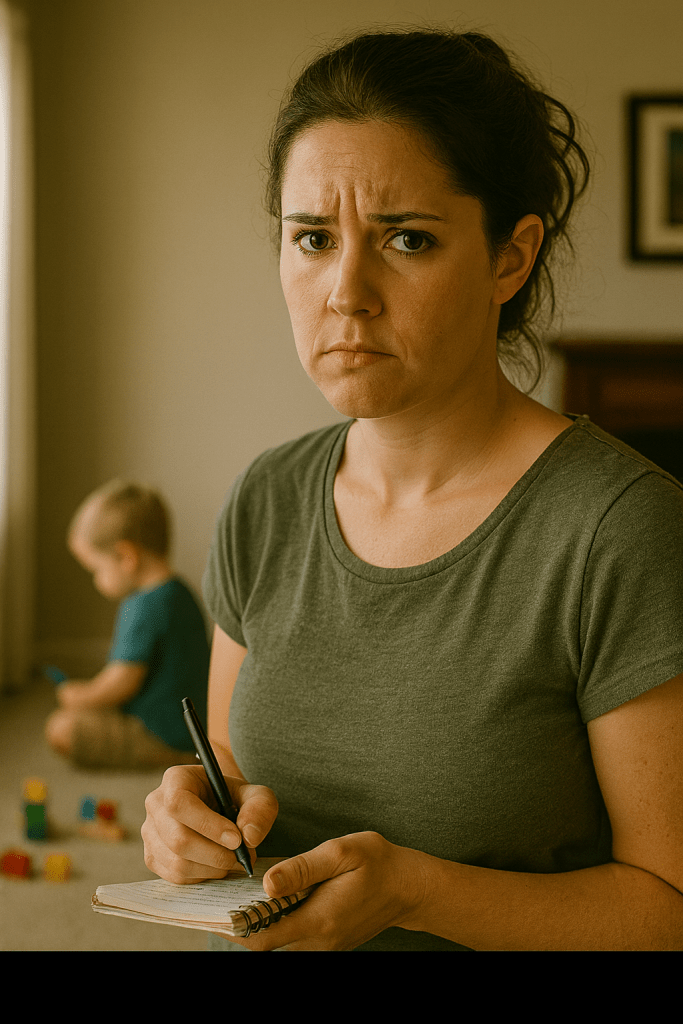
Over the next 18 months, the journal filled with 24 entries. Some were brief and curious. Others left everyone in the room in silence. There was no pattern beyond one: none of it had been introduced by anyone.
The notebook became their way of listening carefully without pushing.
What They Didn’t Do
They didn’t tell Eddie he was Grandpa. They didn’t ask him if he remembered dying, or being sick, or coming back.
They just listened.
If he made a statement, they wrote it down. If he said something that clearly belonged to Frank, they acknowledged it gently.
“Thanks for helping, Eddie. I’m glad you’re here with us now.”
That was straight out of Carol Bowman’s playbook. In Return From Heaven and in her “What a Parent Can Do” chapter, she emphasizes a few simple things: listen without leading, reassure the child that they’re safe now, and keep them anchored in the present. The family followed that guidance instinctively.
When Jo-Jo Heard Her Name
Jo-Jo didn’t like to talk about the afterlife. She was a woman of simple rituals and quiet grief. After Frank’s death, she’d stopped gardening, stopped singing to the old swing records. She rarely smiled.
When Eddie called her “Jo-Jo” for the first time, she froze. Then she walked into the kitchen and cried for ten minutes.
But she didn’t run from it. The next day, she helped Eddie pot a tomato plant. The day after that, she brought out a small plate of sliced tomatoes, just like Frank liked them.
He took a bite, thought for a moment, and said:
“Needs more salt.”
She laughed. It was the first time she had laughed like that in a long while.
The words didn’t erase the grief. But they shifted it.
Echoes, Not Proof
By the time Eddie turned four, the comments had slowed. He still called Jo-Jo by her nickname, but didn’t ask for the pipe anymore. He still preferred tomato plants to toys, and still crossed his leg the same way.
But the specific remarks faded. The night he turned five, they asked him about the red mug. He blinked and said, “That’s Jo-Jo’s mug.”
When they showed him a picture of Frank for the first time at six, he said:
“He looks kind.”
He didn’t recognize him.
The family understood: whatever connection had been there had done its quiet work—and moved on.
Why They Didn’t Go Public
They never posted about it on social media. They never told the neighbors or friends at church. They were afraid of being misunderstood, or of people projecting meaning onto something that had felt so pure and so private.
So they kept the journal. They shared the story only with a few trusted relatives. For years, that was enough.
When parents with similar stories eventually find the Children’s Past Lives Forum, their reasons are much the same. They don’t come looking for publicity. They come looking for reassurance.
They want to know:
- “Are we the only ones?”
- “Is our child okay?”
- “What should we do next?”
The Reincarnation Forum Knows This Story
In thousands of posts collected across decades, same-family reincarnation cases are among the most common—and most quietly powerful—stories in the Forum archive.
A child speaks a nickname no one uses. A grandparent’s mannerisms show up in a toddler. A family feels a thread stitch back into place.
Sometimes the story is dramatic. Often, it isn’t. Often, it’s tomato plants and old chairs and a quiet voice saying, “That’s my spot.”
The Forum doesn’t try to prove these stories. It listens. It honors the moment.
As one long-time moderator put it:
“The goal isn’t to prove anything to the world. It’s to help families feel whole again.”
This family’s story does just that.
A Guide for Other Families
The practical advice that helped this family doesn’t come from nowhere. It comes directly from Carol Bowman’s work—especially the “Handbook for Parents” and “What a Parent Can Do” sections in Children’s Past Lives, and the same-family cases in Return From Heaven.
If your child says something you can’t explain, Carol Bowman suggests:
- Write it down. Keep a notebook. Record exact words, dates, and your observations.
- Don’t lead. Don’t ask suggestive questions. Let your child speak in their own time.
- Reassure gently. Use simple phrases like, “You’re safe now,” or “That was a long time ago.”
- Keep it present-focused. Bring the child back to their current life and relationships.
- Protect privacy. You don’t need to share every detail publicly. Your child’s safety and dignity come first.
Eddie’s family ended up doing all of these things instinctively. The result wasn’t a solved mystery—it was a calmer child and a softer grief.
By the time Eddie started second grade, the journal was packed away. Jo-Jo was back to gardening. The chair still sat by the window. No one called it Grandpa’s anymore. But no one moved it, either.
It was just the chair. And somehow, that was enough.
Names and locations have been changed to protect the family’s privacy. To read more cases like this, or to share your own story, visit the Children’s Past Lives Forum or explore Carol Bowman’s Return From Heaven—still the only full-length book devoted to same-family reincarnation cases.
This case is shared with permission and anonymized for privacy.
Want more for research?
A structured, evidence-focused research version of this case is available as a companion resource. It consolidates the full timeline, reported statements, behavioral correlations, and relevant methodological considerations for readers seeking a more analytical review.Access to the research article is available by application through our contact form. Please note that access is granted only to licensed researchers and clinicians, and is not available to the general public.
Share this article across devices using QR Code below:




 REIGNITE
Leave a comment